


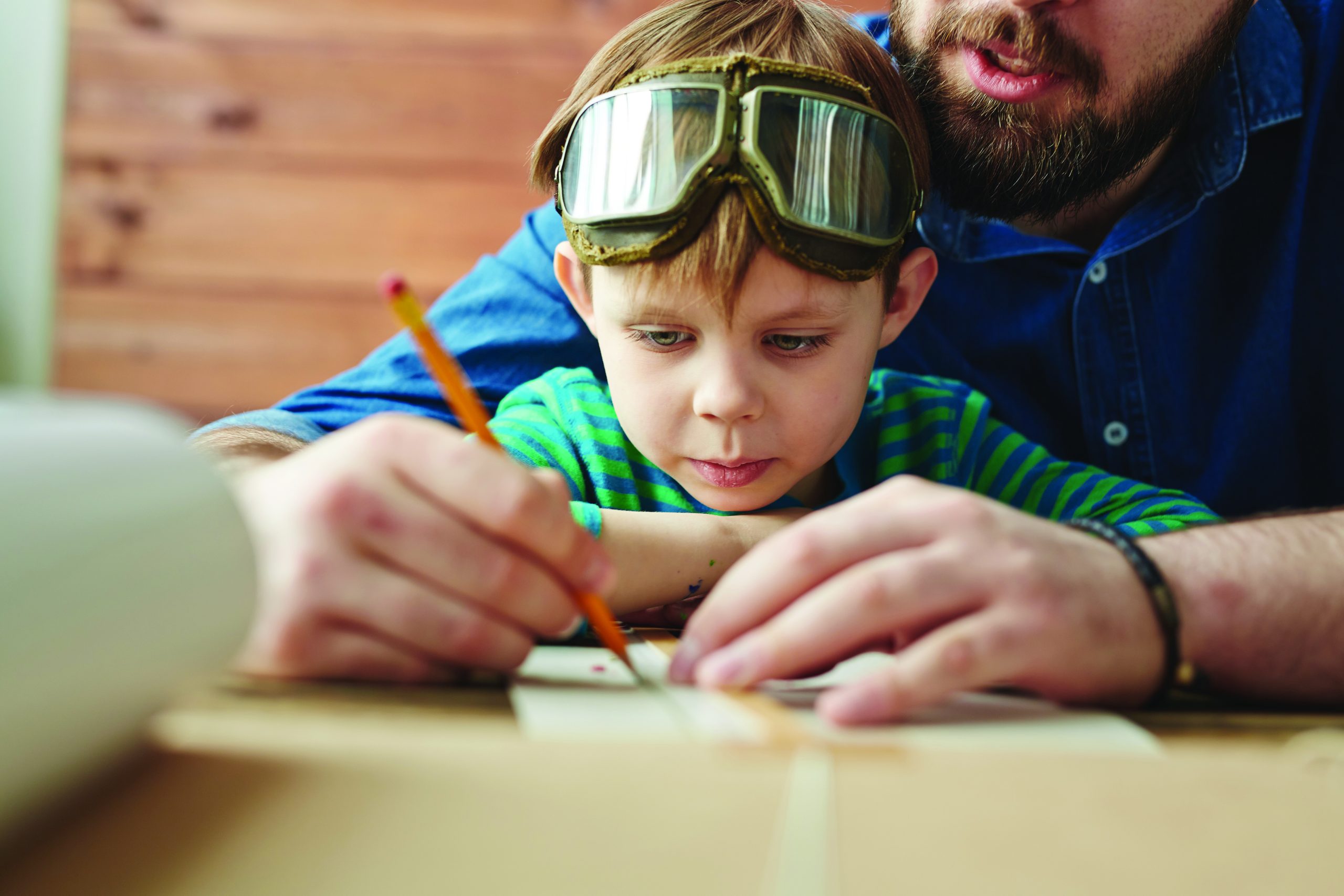
Why good parenting is the best education
By: Paula Levin
If I had a rand for every time I’ve lamented that my children didn’t come with a manual, I’d be a wealthy woman. As much as parenting experts, books and influencers might tell you it’s “5 steps to this” and “6 weeks to that”, we’re all just winging it (don’t tell my kids). Born into parenthood about 20 years ago, I’ve often wondered why there aren’t more guidelines for raising a new generation. Surely there should be some entrance exam, some minimal qualification, some rulebook for life’s highest-stakes project: producing decent humans?
“That’s exactly what’s wrong with parenting today,” says LinksShul’s Rabbi Levi Avtzon. “We see our children as projects. And while we exhaust ourselves seeing to their every ‘need’, to ensure they’re ahead of the game, we sometimes avoid the real work of parenting.” I arrived at Rabbi Avtzon’s office to interview him for this piece because I figured, if the Torah is our instructional manual for life, and in it are 613 commandments, it must have a lot to say about parenting. Rabbi Avtzon began with an anecdote. “A rabbi once came to the Lubavitcher Rebbe and told him about a course he planned on teaching his congregation, called ‘The Ten Commandments of Educating Your Children’. The Rebbe replied, ‘You forgot the 11th. There aren’t any.’” And yet, the foundations of our faith — the exodus from Egypt and receiving the Torah at Mount Sinai — are transmitted in each generation from parent to child. This unbroken chain of transmission from parent to child is actually how we know the exodus from Egypt happened in the first place. Every person alive then was tasked with the commandment “you shall tell your children on that day”, commanded to eat matza, bitter herbs and the Passover offering each year on the 14th of Nissan, and tell our children how G-d took us out of Egypt. So clearly what we do as Jewish parents is essential to G-d’s plan! Why, then, is it not spelled out? Where’s the manual?
“Our entire faith is passed on through the relationship between parent and child, and relies on the fact that every parent wants what’s best for his or her child and will tell them what is in their best interests,” says educational counsellor and director of The Space, Rabbi Elimelech Gartner. “So it’s clear Hashem trusts us to raise and teach our children — without a manual. Animals aren’t confused about how to raise their young. Only humans are, because we have stopped trusting ourselves. The Torah says there are three responsibilities a parent has towards his child: teach your children Torah, teach them a profession, teach them to swim. That’s it.”
“Our children don’t need to be taught to navigate life with integrity – they need to see us do it.”
I asked Rabbi G why there aren’t more Torah laws about how exactly we educate our children, and he pointed to a proverb from King Solomon. “Teach a child according to his way, and he will never depart from it.” “This is telling us to get to know our child and give him or her the space to be themselves, not clones of ourselves. Be curious. Respect their individual journey. The most important part of educating your child is to get to know them, and everything flows from that connection and that bond.” Rabbi G explains that the three laws mentioned above speak to three areas of parental responsibility. Teaching our children Torah refers to conveying a moral code and appropriate behaviours (Derech Eretz) to guide their lives. Teaching a profession is to ensure they become independent and can thrive. Teaching them to swim is to ensure they have everything they need to survive. He also quotes King Solomon’s proverb, “Listen, my son, to the Mussar of your father and the Torah of your mother”, and explains that these are not literal gender roles but areas of life that need to be taught specifically by parents. Mussar covers self-discipline, ethics and life’s practical dos and don’ts, while Torah is the transformational Jewish journey from a person’s more animalistic impulses to his higher, G-dly self – the journey to being a mensch, and revealing the G-dly soul within.
“Education must be our vision. Schools should be employed to execute that vision.”
“As parents, we’ve lost our way because we’ve come to expect everything to be prescriptive,” says Rabbi G. “Torah is not prescriptive; not all of life fits into a set of rules or neat categories. Hashem trusts us to figure things out for ourselves. Intuition, instinct and ability are built in. The other issue is that we live in a world where we outsource so many things.” There’s an organisation and an expert and a company for everything. The problem with outsourcing is not the getting of help — we can certainly utilise the resources the world has developed. The problem is abdicating responsibility, he explains. A parent can certainly send a child to school as a way to prepare him or her for a profession and to learn Torah, but it’s important to remember that the school is not their partner; it is their agent — there’s a big difference between the two. As wonderful as the school is, the responsibility still lies 100% with the parent. Education must be our vision. Schools should be employed to execute that vision. We need to start by asking, “What do I want for my child?” Most people answer that they want their child to be happy. We need to want more: to want them to be successful in what they do, to raise a family, to contribute to their community and to society. Ask yourself, where do you want your child to be in ten years? Yes, it takes a village – but at every step, you need to be involved and see who’s in your child’s village.
We mentioned the exodus as one of the Torah sources for educating our children, but of course education doesn’t happen once a year. Another central source comes from the words of the Shema. The Torah verses beginning “Listen, Israel, the Lord our G-d, the Lord is One” are followed by three paragraphs, written in the tefillin, in the mezuza, and recited twice every day. There we find the instruction to parents: “All these words which I command you today, you shall teach them thoroughly to your children, and you shall speak of them when you sit in your house and when you walk on the road.” Rabbi Avtzon points out that teaching our children is actually step two of the Shema. “Step one is the verse before: ‘And you shall love Hashem with all your heart, all your soul and all your might.’ Our job as parents is to raise ourselves. Every day we need to be a better version of ourselves, to love G-d with everything we are and everything we have, and reflect that love in our behaviour. That’s the job of educating children. We don’t teach our children how to live a Jewish life – we live it, and they learn by osmosis,” he explains.
Osmosis, however, takes time and proximity, something that parents and children had together in abundance in previous generations. “Too many people today are chasing ‘quality time’ – those intentional, fully present moments of connecting to our children and sharing what our values are. Quality time is for grandparents, aunts and uncles,” says Rabbi Avtzon. “What our children need from us is quantity time! They need to see us argue with our spouses, respectfully. Feel sick, miserable or angry – and self-regulate, not lash out. They need to see us make decisions that reflect our values, like giving charity to the poor, not only indulgent gifts to them. We hide behind words. We say that family, community, kindness and charity are important, but which value trumps which? Which values are we living? What would your children tell you your values are? Our children don’t need to be taught to navigate life with integrity; they need to see us do it. They need to see people at our Shabbos table who have nowhere else to be. They need to see us give charity and build our communities, with money and time invested, not just talk. What is the emphasis in your home? What do you say to your kids most of the time? Study. Have you done your homework? Every home has things on repeat. Look at that. This is what the Torah means when it says ‘when you sit in your house, walk on the road, when you lie down at night and get up in the morning’,” says Rabbi Avtzon. In an increasingly distracted, busy world, what are our children seeing? Are we home enough? Are we with our children sitting in the house, going about our day, connecting at bedtime and engaging in the morning? Because that’s where real education happens.
Rabbi G explains that there are things we can only learn at home – they cannot be found in textbooks or lectures. We can learn an attitude of openness and curiosity towards others, and the belief that we can learn from everyone. We can learn to be happy with and grateful for what we have. We can learn how to give, to share, to say sorry and to be a friend. We learn adaptability and flexibility when things don’t work out. Schools teach collaboration – how to work with others to achieve a common goal. Home teaches care that isn’t transactional. Home teaches love, empathy, consistency. Schools reward achievement. Home teaches our intrinsic worth, regardless of achievement. Schools enforce consequences; home teaches choosing the right thing even when no one is watching.
Rabbi Avtzon advises that as parents, we use our inbuilt moral compass. “The Chizkuni points out that the generation of the flood were accountable for their behaviour even though they lived before any laws had been given.” We have a soul; we need to listen more closely to what it’s saying. We also need to constantly feed ourselves a diet of Torah from good and wise people, and take on healthy and holy habits, so that when we trust our intuition, it is our G-dly soul that speaks louder than our animalistic instincts. “We can’t trust our gut if we’ve fed it junk food, if most of our ideas are from watching the news and sitcoms, or reading books by people who throw philosophies around but haven’t lived them and don’t have a 3 000-year-old Mesora (tradition). Our gut can’t be trusted if we’ve injected it with an unhealthy diet of ideas and worldviews.”
Finally, says Rabbi Avtzon, we need to surround ourselves with wise people who aren’t afraid to call us out on our parenting. “Create an ecosystem around you that brings out the best in you, so you can bring out the best in your child. At the end of the day, as much as our schools have dedicated themselves to Jewish education, the school experience bears little resemblance to real life. While at school, among peers, popularity, achievement and status symbols all seem very important. Home has the power to counteract these influences. Ultimately, you can’t teach your child how to be a mensch. They have to see you be a mensch.”
And that’s why there’s no place like home for Jewish education.